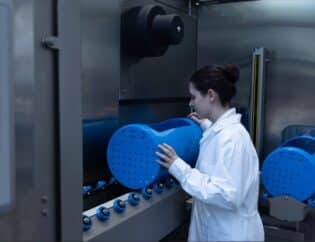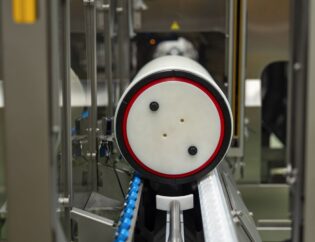




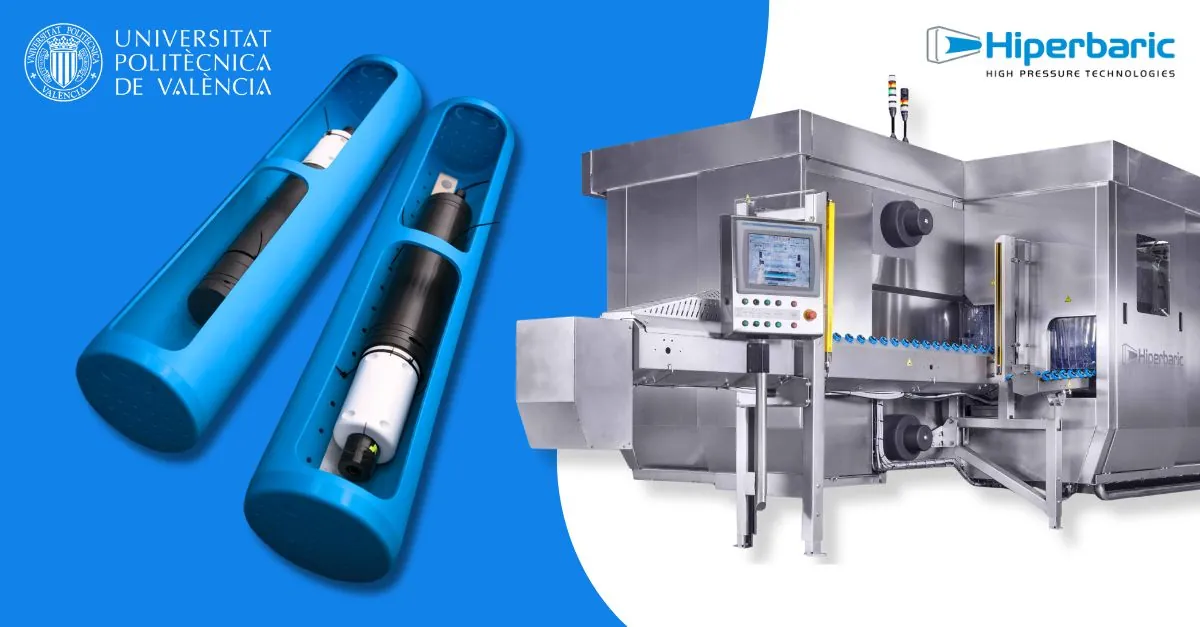

The acoustic beacons of the submerged telescope at the bottom of the Mediterranean were designed by the University of Valencia and manufactured by the Valencian company Mediterráneo Señales Marítimas. Hiperbaric subjected these beacons to high-pressure resistance cycles. This process, which involved exposure to 500 bar of pressure, ensured the beacons’ quality under extreme conditions and helped capture the highest-energy cosmic neutrino signal to date.
Hiperbaric’s high-pressure technology has contributed to the detection of the highest-energy neutrino ever observed. The technology made it possible to subject the beacons of the telescope submerged at the bottom of the Mediterranean, which was the one that managed to capture this particle, to high-pressure cycles.

Treating these beacons at 500 bar pressure guaranteed their quality in extreme conditions and enabled the capture of a signal about 30 times stronger than those previously detected. This triumph was achieved by the European Cubic Kilometer Neutrino Telescope (KM3NeT), which is located underwater.
This telescope consists of two detectors, ARCA and ORCA, which are submerged at depths of 3,450 and 2,450 meters, near Sicily (Italy) and Provence (France). The former studies the properties of neutrinos, while the latter hunts for the highest-energy cosmic neutrinos.
The ARCA detector was the one that observed the signal in February of this year, opening a new window through which to study the universe with the help of Hiperbaric’s 100% Spanish high-pressure technology.

“The company is very proud to have contributed to this significant scientific discovery. We subjected the beacons, which were designed by the Universitat Politècnica de Valéncia and built in collaboration with the Valencian company Mediterráneo Señales Marítimas, to high-pressure resistance tests. Our technology ensures they function properly in extreme conditions, enhancing their performance,” explains Andrés Hernando, Hiperbaric’s CEO
Neutrinos are the tiniest and most enigmatic elementary particles. They are extraordinary messengers that carry valuable information about extreme conditions and phenomena that are not fully understood, such as those occurring near black holes or supernova explosions. The detection of this new signal ushers a new era of cosmos study.

The immense telescope that is being built in the depths of the Mediterranean will, once completed, occupy more than a cubic kilometer. It will have 345 detection units, each of wich is a cable hundreds of meters long anchored to the bottom with 18 spherical modules resembling the beads of a necklace. In total, the telescope will have approximately 200,000 sensors that convert the weak flash of light caused by neutrinos into electrical signals. Hernando concludes, “From the company’s innovation department, we hope to continue to have more opportunities to extend our collaboration with the University of Valencia to other entities committed to high-pressure technology to improve the quality of the most demanding components.”