



For decades, the food industry has faced a basic challenge: how to guarantee safety while still delivering a product that looks, tastes, and feels appealing. This applies not only to shelf-stable foods, but also to refrigerated products that require spore control. Traditional thermal methods remain essential for these applications, but they often achieve safety at the expense of product quality. As consumer demand shifts toward products with a more natural, less “overprocessed” profile, this tradeoff has become a key strategic issue for product developers and processors.
Retort has long been the industry’s main solution for thermally processed packaged foods, including both shelf-stable products and refrigerated products that rely on heat treatment for microbial control. It is well established, widely accepted by regulators, and highly effective for large-scale production. However, the same thermal intensity that makes retort reliable can also limit quality in many products. High Pressure Thermal Processing (HPTP) offers a different approach. By combining pressure with heat, HPTP can deliver spore inactivation performance while limiting the damage associated with conventional thermal processing.
Understanding retort
Retort processing remains a global standard for a wide range of packaged foods that require thermal treatment. It uses external heat transfer, typically through steam, to process foods that have already been sealed in containers such as cans, jars, glass containers, or pouches. The process is widely used because it is scalable, cost-efficient for high-volume goods, and supported by a mature regulatory framework with well-established thermal processing models.
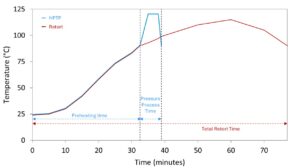
A retort cycle generally operates between 90°C and 130°C (194°F and 266°F), depending on product formulation, pH, target microorganism, and intended distribution conditions. The cycle includes three main stages:
- Heating: Raise the product to the target temperature.
- Holding: Maintain the product at the target temperature for the necessary time to achieve the required lethality.
- Cooling: Reduce the product temperature to finish the process.
This approach is effective, but because heat moves from the outside of the package toward the center, it is inherently slower and not uniform.
The slow heat transfer creates one of retort’s main drawbacks: thermal lag. To ensure the coldest point in the package reaches the required process conditions, the outer layers are often exposed to more heat than necessary. In practice, product temperature also remains elevated during the cooling phase, and the vessel cannot be opened immediately. This extends the overall thermal burden and can contribute to cooked flavors, browning, soft or mushy textures, and loss of heat-sensitive nutrients and bioactive compounds. It can also increase energy demand and place limits on packaging design.
High Pressure Thermal Processing
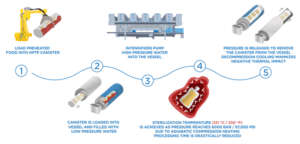
High Pressure Thermal Processing, instead of depending mainly on slow heat transfer by conduction or convection, combines an initial moderate temperature with high hydrostatic pressure, allowing the product to heat rapidly and more uniformly through adiabatic heating during compression. HPTP operates at pressures of up to 600 MPa (6000 bar; 87023 psi), with an initial temperature range of 70–90°C (158–194°F), after which compression further increases product temperature up to 90-121°C (194-250°F), which is the target range for the destruction of bacterial spores.
A standard HPTP cycle usually involves the following steps:
- Pre-heated products are loaded into pre-heated carriers;
- Carriers are transferred into the high pressure vessel, which is filled with water;
- Pressure is increased to the target level;
- The combined pressure-temperature treatment is held for the required time;
- After the hold, pressure is released within seconds;
- Product is cooled to stabilize it after processing.
Because temperature drops rapidly on decompression, the product is exposed to severe thermal conditions for a shorter overall time than in conventional retort. This sequence helps reduce the total thermal burden.
Since heating occurs rapidly and uniformly, HPTP can shorten the time the product spends under severe thermal stress. That lower total thermal load is central to its value proposition. Rather than replacing retort in every case, HPTP expands the options available for products where sensory quality, nutrient retention, and premium positioning are important.
Why HPTP stands out
Better sensory quality potential
- HPTP can help preserve color and texture more effectively in many products by reducing total thermal exposure.
- In low-acid fruit and vegetable purees, color changes remained limited in several matrices, although more heat-sensitive pigments may still be affected (Ghamdi et al., 2020).
Improved nutrient retention
- HPTP has shown better retention of heat-sensitive compounds such as carotenoids compared with conventional retort (Gratz et al., 2021).
- This is linked to the pressure-temperature synergy, which can achieve microbial inactivation with lower cumulative thermal damage.
Lower formation of some thermal contaminants
- HPTP has also shown the potential to reduce compounds such as furan and related contaminants compared with retort (Gratz et al., 2021).
- This is another consequence of the lower overall thermal load.
A broader product opportunity
- HPTP is especially relevant when safety must be combined with a fresher, less heavily processed eating experience.
- This can be valuable in premium formulations where color, flavor, texture, and nutrient quality are part of the product proposition.
Head-to-head comparison: retort vs. HPTP
The comparison in Table 1 highlights the core difference between the two technologies. Retort remains highly effective and practical for many established thermally processed foods, especially when scale, packaging flexibility, and cost are the main priorities. HPTP becomes especially attractive when quality retention is a central part of the product’s value proposition.
| Category | Retort | HPTP |
| Main mechanism | External heat transfer by conduction/convection | High pressure combined with adiabatic heating |
| Typical temperature profile | 90–130°C (194°F and 266°F) | 70–90°C (158–194°F) initial temperature, with temperature rise during compression up to 90-121°C (194-250°F) |
| Heating behavior | Slower; not uniform | Rapid; uniform |
| Cooling | Slower cooldown; product can remain hot while the retort completes the cooling phase and before the vessel can be opened | Rapid temperature drop after pressure release, helping reduce residual thermal impact |
| Sensory impact | Cooked profile, greater texture and color loss | Better retention of fresh-like sensory qualities |
| Nutritional impact | Greater degradation of heat-sensitive compounds | Better retention of compounds such as carotenoids |
| Contaminant formation | Higher thermal burden can increase contaminant formation | Lower thermal burden can reduce formation of some contaminants |
Choosing the right technology
Retort remains the right choice for many high-volume, cost-sensitive foods where a traditional cooked profile is expected, and price competitiveness is essential. It is a proven and widely adopted solution for many thermally processed packaged foods and continues to play a central role in the global food industry. It is also a strong fit for products packed in glass, since this packaging material is not suitable for high pressure processing.
HPTP is better suited to products where conventional retort would compromise the intended eating experience. Premium ready meals, delicate purees, baby foods, and other value-added products can benefit from the lower thermal load of HPTP, especially when color, texture, flavor, and nutritional quality are important to the brand or end consumer. In that sense, HPTP is a way to make certain premium thermally processed products more feasible.
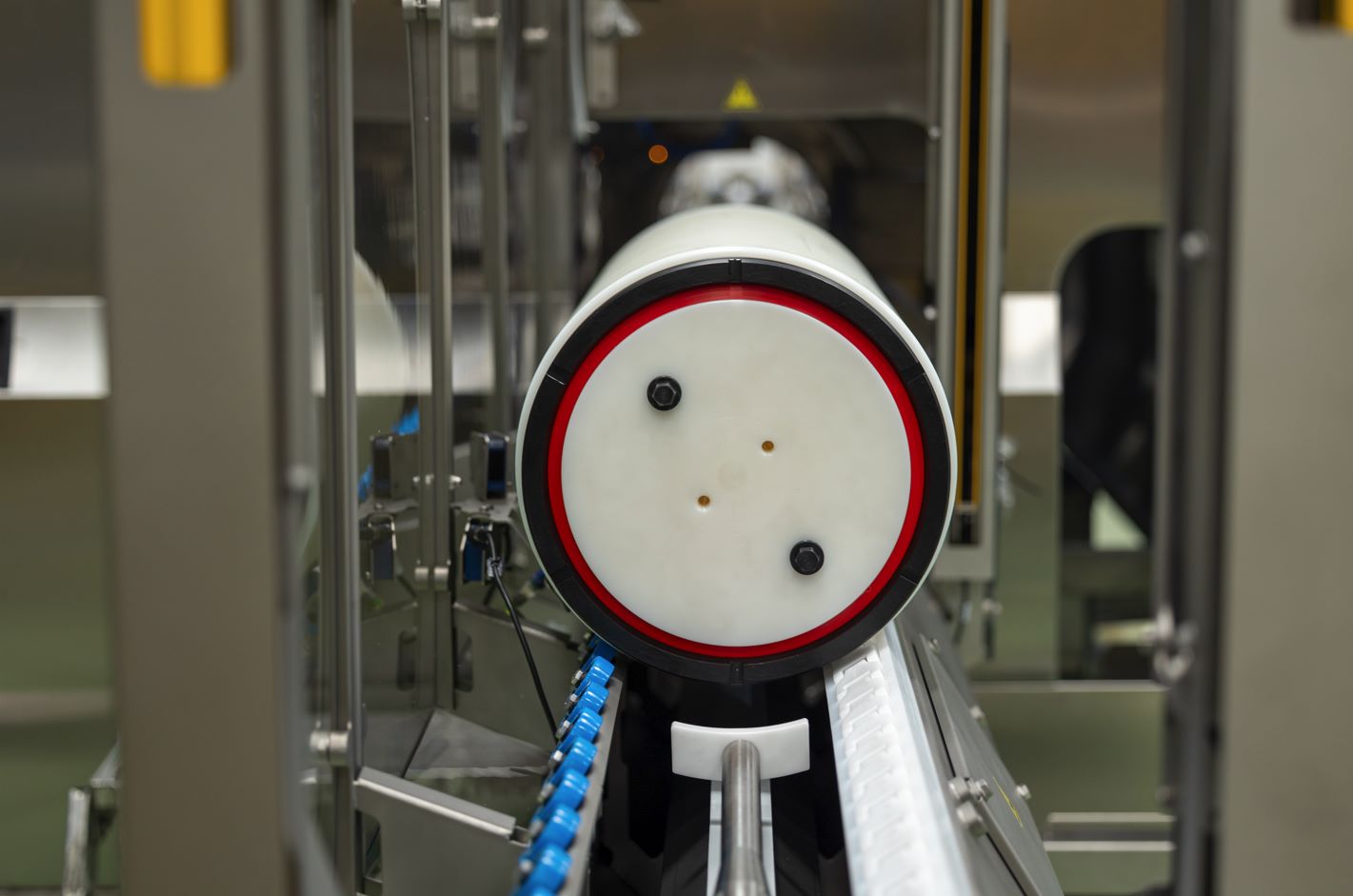
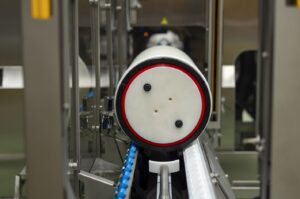
A practical approach to implementing HPTP is currently accessible through the partnership between Hiperbaric and CSIRO. Specifically, an insulated carrier developed and patented by CSIRO, subsequently enhanced by Hiperbaric, facilitates HPTP functionality on existing Hiperbaric HPP machines.
Conclusions
Shelf-stable versus refrigerated is not the only way to think about thermal processing anymore. Across both categories, processors are increasingly expected to deliver safety together with better quality, cleaner sensory profiles, and stronger nutritional value. This is where HPTP has growing relevance. By reducing the tradeoff between safety and quality, it opens new possibilities for thermally processed foods that aim to deliver a more premium, less heavily processed experience. Retort will continue to be essential for many applications, and HPTP is not a universal replacement. But where product differentiation depends on preserving sensory and nutritional quality while still achieving the required microbial control, HPTP offers a compelling alternative to traditional thermal processing.