



Summer 2026 put Cyclospora back in the headlines. Here’s what the science says about high pressure and this tough little parasite.
This summer, a salad ingredient became one of the year’s biggest food safety stories. The investigation linked a multistate outbreak to processed iceberg lettuce from Taylor Farms de Mexico that was contaminated with Cyclospora, and on July 17, 2026, the company recalled all iceberg lettuce sourced from central Mexico. When the CDC declared the outbreak over on September 11, the final count stood at 12,883 illnesses across 21 states, with at least 570 hospitalizations and two deaths.
Where People Got Sick: Cyclospora Outbreak, July 2026
That’s a lot of people, and a good reason to ask: what else can processors do?
Meet the troublemaker
Cyclospora cayetanensis is a microscopic parasite that spreads through contaminated food or water. Fresh produce like basil, cilantro, raspberries, lettuce, and berries has been linked to outbreaks before.
What makes it tricky is its armor. Cyclospora travels in tough-walled oocysts (think of them as tiny protective capsules) that shrug off washing and standard chemical sanitizers. That’s why controlling raw materials at the source matters so much.
Why HPP enters the conversation
HPP applies high water pressure, typically 400–600 MPa / 58,000–87,000 psi, to food that’s already packaged. No heat, no added chemicals, and the pressure reaches every part of the product equally, whatever its size or shape.
So the real question is simple: can pressure crack the parasite’s armor and make it non-infective?
What the research shows
Here’s the honest part first: there’s no published HPP study on Cyclospora itself. That’s not for lack of interest. The parasite can’t be grown in the lab or in standard animal models, which makes direct testing extremely difficult.
So researchers do the next best thing and study close relatives:
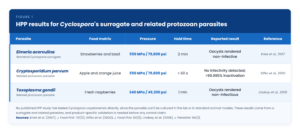
1. The stand-in: Eimeria acervulina on strawberries and basil
Study: “High Hydrostatic Pressure and UV Light Treatment of Produce Contaminated with Eimeria acervulina as a Cyclospora cayetanensis Surrogate” (Kniel et al., 2007). Eimeria acervulina is the standard lab substitute for Cyclospora.
Result: At 550 MPa / 79,800 psi for 2 minutes, the oocysts were rendered non-infective.
2. The juice case: Cryptosporidium parvum in apple and orange juice
Study: “Effect of High Hydrostatic Pressure on Cryptosporidium parvum Infectivity” (Slifko et al., 2000). Cryptosporidium is a related parasite with a similarly tough-walled oocyst.
Result: At 550 MPa / 80,000 psi, just 30 seconds reduced oocyst infectivity by at least 3.4 log. After 60 seconds or more, no infectivity was detected, corresponding to more than 99.995% inactivation.
3. The berry case: Toxoplasma gondii on raspberries
Study: “Effects of High Pressure Processing on Toxoplasma gondii Oocysts on Raspberries” (Lindsay et al., 2008). Toxoplasma is another related parasite spread through oocysts.
Result: A much milder 340 MPa / 49,300 psi for 1 minute rendered the oocysts inactive and non-invasive.
Three different parasites, three different foods, one consistent message: pressure can take down some very well-armored oocysts.
What this means for processors
The results are encouraging for a few reasons. Commercial HPP lines often run at higher pressures and longer hold times than these studies used, which may add an extra safety margin. And because HPP works without heat or chemicals, it’s an option for products where freshness is the whole point.
That said, a few ground rules apply:
- Surrogates aren’t the real thing. These results point in the right direction, but they aren’t direct Cyclospora validation. Any claim should say clearly that it’s based on surrogate data.
- Your product is its own experiment. Results depend on the food, pressure, hold time, and temperature, so conditions can’t simply be copied from one product to another. Product-specific validation comes first.
- HPP isn’t a fit for every fresh product. Pressure works best on packaged foods that handle it well, so quality needs to be checked case by case.
- HPP is a teammate, not a solo act. It works best alongside supplier controls, documented Cyclospora measures, and strict washing and sanitation practices.
The bottom line
This summer’s outbreak was a reminder that washing alone can’t always stop a parasite built to survive it. The science on HPP isn’t complete yet, but the surrogate data is promising: pressure has made related parasites non-infective in berries, herbs, and juice. For processors of products like berry purées, herb sauces, salsas, and juices, HPP is well worth a closer look as part of a layered food safety plan.
Want to explore HPP for your produce-based products? Drop your questions in the comments or reach our food science team at [email protected]