



As a leader in high-pressure technology, the company plays a strategic role in the design and engineering of the valley’s future multimodal refueling station. Thanks to its advanced compression systems, capable of reaching 900 bar, Hiperbaric guarantees a continuous supply for heavy and light-duty fleets, consolidating a key, scalable infrastructure to connect hydrogen production with the real-world needs of mobility and industry.

Hiperbaric is actively involved in CyLH2Valley, one of the most ambitious European projects deployment of renewable hydrogen under real operating conditions. The project relies on a network of interconnected facilities spanning from production to end-use in mobility and industry, allowing for the analysis of the system’s performance as a whole. In this context, Hiperbaric brings its expertise in high-pressure technology and applied engineering, contributing to the development of infrastructure capable of managing large volumes of hydrogen continuously and efficiently.
Its contribution is particularly visible in a high-flow refueling station located in Burgos, designed to serve light and heavy-duty vehicles, as well as regional distribution via tube trailers. This approach reflects Hiperbaric’s vision within the project: technical solutions designed to scale, integrate into industrial environments, and accompany the growth of hydrogen as an energy vector.
CyLH2Valley: A Hydrogen Valley for a Real Energy Transition
CyLH2Valley is a European project designed to verify, through data and real-world operations, how renewable hydrogen can be effectively integrated into industrial, mobility, and energy systems. Funded by the Clean Hydrogen Partnership under the Horizon Europe program, the project is primarily developed in Castile and León and features the participation of more than 35 partners, including industrial companies, technology providers, research centers, and public administrations.
The project is structured into 11 interconnected pilots covering the entire hydrogen value chain, from production and transformation to distribution, storage, and various end-uses. This configuration allows for the analysis of the system’s behavior as a whole, evaluating how infrastructures, consumption, and energy flows interact under real operating conditions.
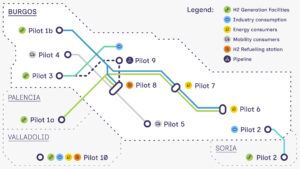
This entire deployment will culminate in a continuous operation period scheduled between 2028 and 2030, during which the valley will function as an integrated regional system. During this phase, CyLH2Valley will simultaneously manage the production, distribution, and consumption of renewable hydrogen in industrial and mobility environments, with volumes exceeding 17,000 tons of hydrogen per year. This scale, unusual for demonstration projects, establishes the valley as a real-world testbed to evaluate capacities, technical limits, and replicable operational frameworks, turning Castile and León into one of the European benchmarks for the industrial deployment of hydrogen.
Hiperbaric’s Role in Hydrogen Refueling Stations
Hiperbaric’s participation in CyLH2Valley lies at the core of the technical design of the hydrogen refueling station, addressing one of the most critical elements from a system engineering perspective: high-pressure hydrogen compression. Its contribution focuses on developing and integrating solutions capable of guaranteeing operational capacity, refueling times compatible with real-world use, and room for infrastructure growth as demand evolves.
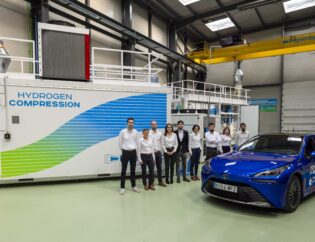
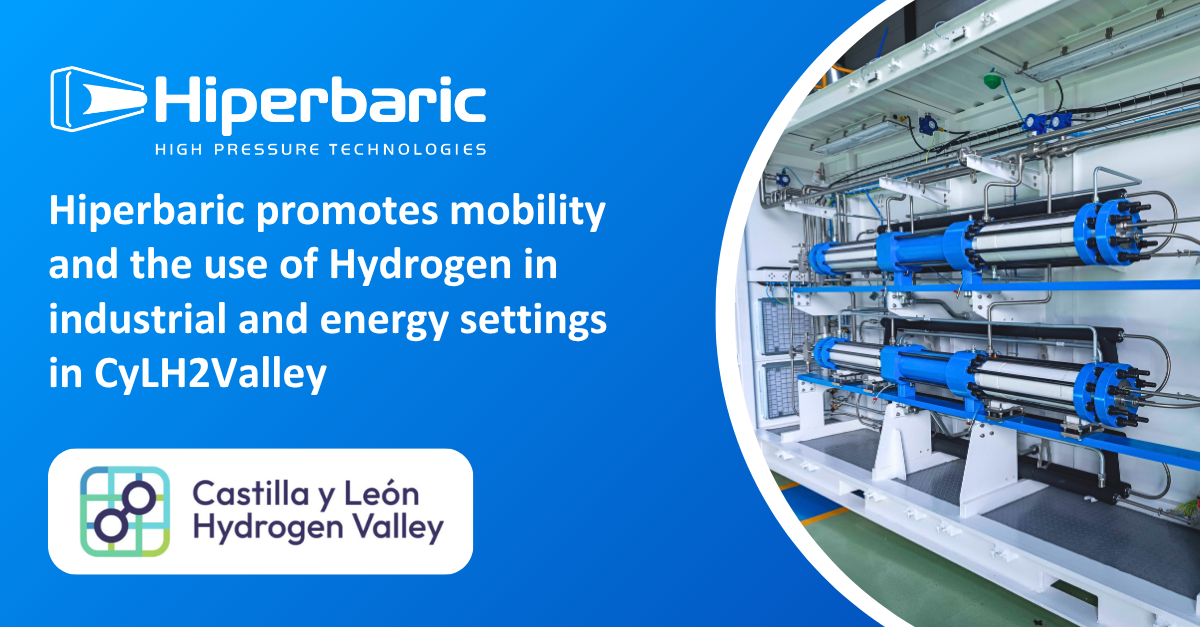
At the hydrogen refueling station, Hiperbaric is responsible for the compression systems that raise hydrogen pressure from supply levels to values up to 900 bar—a necessary condition for both storage and vehicle refueling in H35 (350 bar) and H70 (700 bar) modalities. The compression architecture is based on modular, multi-stage solutions, allowing the system to be adapted to different operating modes without compromising stability or performance.
This configuration meets engineering criteria oriented toward continuous operation and flexibility, enabling the refueling station to serve highly diverse usage profiles within the same facility: from refueling heavy and light mobility fleets to loading tube trailers destined for regional hydrogen distribution. The compression systems supplied by Hiperbaric ensure that hydrogen is available at the required pressure levels for storage and refueling, meeting the flow rate and operational continuity requirements defined for the hydrogen refueling station.
The result is a hydrogen refueling station conceived from its foundation for real-world use, not limited to isolated or demonstration scenarios. The compression engineering developed by Hiperbaric allows the infrastructure to maintain its functionality in the face of progressive increases in demand, shifts in consumption patterns, and future developments within the valley. In this way, the company’s contribution translates into a solid technical foundation upon which to build scalable, integrated hydrogen systems aligned with the real needs of mobility and industry.
Hydrogen Refueling Station: Mobility, Industry, and Regional Distribution
The high-capacity hydrogen refueling station is located in the Villalonquéjar Industrial Park in Burgos, and will be jointly developed by Hiperbaric, Aciturri, Beroil, and Desmasa. The facility is conceived as a multimodal infrastructure within CyLH2Valley, prepared to serve both light and heavy-duty mobility as well as regional hydrogen distribution.
The station is designed to receive hydrogen through two complementary pathways: via tube trailers coming from the valley’s production plants and through a pipeline connected to another production plant in the project. This dual input allows for operation under different supply schemes at a single site. From there, the hydrogen is compressed in two stages, stored at different pressures, and supplied to fuel cell vehicles in two modalities: up to 350 bar and up to 700 bar. In addition, the facility includes a dedicated 500-bar filling line for preparing tube trailers used in the regional distribution of hydrogen for industrial and residential applications.
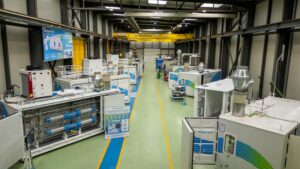
In terms of capacity, the station has been dimensioned for a daily refueling of around one ton of hydrogen, enabling refueling times compatible with real-world operations: around five minutes for passenger cars and up to twenty minutes for heavy-duty vehicles, in line with the demands of fleets and transport services. The compression systems also allow for a continuous input of hydrogen from the tube trailers, while the dispensation flow rates adjust to the type of vehicle and the applicable refueling protocols.
Hiperbaric and the Future of Hydrogen
Hiperbaric’s participation in CyLH2Valley solidifies its role as a key technological partner in developing hydrogen infrastructures designed to operate under real conditions and at an industrial scale. Through its expertise in high-pressure technologies and applied engineering, the company contributes to projects where hydrogen stops being a theoretical concept and becomes an operational system, capable of integrating into mobility and industrial environments with real demands for capacity, availability, and continuity of service.
Hiperbaric’s contribution is geared toward solving some of the most critical technical challenges in the deployment of hydrogen: managing high pressures, ensuring system reliability during continuous operation, and providing the infrastructure with the capacity to adapt to the progressive growth of demand. This approach, supported by robust and scalable technical solutions, enables us to keep pace with the evolution of hydrogen without compromising the system’s industrial coherence.
Behind this contribution is Hiperbaric’s engineering and development team, which possesses extensive experience in designing and manufacturing high-pressure solutions applied to demanding industrial sectors. The knowledge accumulated in complex projects, combined with a practical understanding of system operation and maintenance, allows hydrogen challenges to be addressed from a realistic, long-term perspective.
Technical Alliance and Vision for the Future
The progress of CyLH2Valley relies on continuous coordination among partners to ensure technical alignment and the tracking of results. Within this collaborative framework, the consortium meeting in Soria, held on May 19 and 20, provided an opportunity to review the status of the initiatives, share insights, and consolidate the planning for the next phases of the hydrogen valley. This collective process reinforces the nature of a project where shared expertise helps build a coherent, scalable hydrogen ecosystem prepared for long-term operation.